
🛣️ Week 10 - Lab Roadmap
Introduction to Natural Language Processing in Python
📚 Preparation: Loading packages and data
⚙️ Setup
⚠️ Windows Users: Some libraries in this lab, particularly
bertopicandsentence-transformers, may stall or hang when imported in standard Jupyter Notebook or VSCode. If you experience this, we recommend opening and running this file in JupyterLab instead (jupyter labfrom your terminal). JupyterLab handles multiprocessing-based imports more reliably on Windows.
Downloading the student notebook
Click on the below button to download the student notebook.
Downloading the data
Download the datasets we will use for this lab.
Use the links below to download this dataset:
Install missing libraries:
First, install all required packages using conda:
# Core data science libraries
conda install -c conda-forge pandas numpy matplotlib seaborn

# Text processing and NLP
conda install -c conda-forge wordcloud textblob nltk spacy

# Machine learning libraries
conda install -c conda-forge scikit-learn lightgbm xgboost shap

# Modern NLP and topic modeling
conda install -c conda-forge bertopic sentence-transformers

# Visualization
conda install -c conda-forge plotly

# Install spaCy English model
python -m spacy download en_core_web_sm
💡 Prefer conda over pip where possible —
conda-forgebuilds are compiled against consistent native libraries and tend to avoid the DLL/dependency conflicts that can causebertopicandsentence-transformersto stall on Windows. If a package is not available onconda-forge, fall back topip install <package>afterwards.
Import required libraries:
# Core data manipulation and analysis
import pandas as pd
import numpy as np
import matplotlib.pyplot as plt
import seaborn as sns
import warnings
warnings.filterwarnings('ignore')

# Text processing and NLP
import re
import string
from wordcloud import WordCloud
from textblob import TextBlob
import nltk
from nltk.corpus import stopwords
from nltk.tokenize import word_tokenize
from nltk.stem import WordNetLemmatizer
import spacy

# Machine learning and model evaluation
from sklearn.model_selection import train_test_split
from sklearn.feature_extraction.text import CountVectorizer, TfidfVectorizer
from sklearn.metrics import (
    classification_report,
    confusion_matrix,
    f1_score
)
from sklearn.ensemble import RandomForestClassifier
from sklearn.linear_model import LogisticRegression
from lightgbm import LGBMClassifier

# Model interpretation and explainability
import shap

# Modern topic modeling
from bertopic import BERTopic
from sentence_transformers import SentenceTransformer

# Advanced visualization
import plotly.express as px
import plotly.graph_objects as go
from plotly.subplots import make_subplots

# Download necessary NLTK data (run once)
print("Downloading NLTK data...")
nltk.download('punkt', quiet=True)
nltk.download('punkt_tab', quiet=True)
nltk.download('stopwords', quiet=True)
nltk.download('wordnet', quiet=True)
nltk.download('omw-1.4', quiet=True)
print("NLTK downloads complete!")

# Load spaCy model (make sure it's installed: python -m spacy download en_core_web_sm)
try:
    nlp = spacy.load("en_core_web_sm")
    print("spaCy model loaded successfully!")
except OSError:
    print("⚠️  Please install spaCy English model: python -m spacy download en_core_web_sm")
    nlp = None

# Set plotting style
plt.style.use('seaborn-v0_8')
plt.rcParams['figure.figsize'] = (10, 6)
plt.rcParams['font.size'] = 12

print("All libraries imported successfully! 🎉")
🥅 Learning objectives
- Develop new data structures needed for NLP (e.g. document feature matrix, corpus)
- Visualise text output using wordclouds and keyness plots
- Perform feature selection to aid in classifying sentiment
- Create and validate topic models using Latent Dirichlet Allocation
A new data set: European Central Bank (ECB) statements (5 minutes)
# Load data

# Convert sentiment to categorical labels

# Remove any missing values
Dataset shape: (2563, 3)
Columns: ['text', 'sentiment', 'sentiment_label']
Sentiment distribution:
sentiment_label
Negative 1609
Positive 954
Name: count, dtype: int64| text | sentiment | sentiment_label | |
|---|---|---|---|
| 0 | target2 is seen as a tool to promote the furth… | 1 | Positive |
| 1 | the slovak republic for example is now home to… | 1 | Positive |
| 2 | the earlier this happens the earlier economic … | 1 | Positive |
| 3 | the bank has made essential contributions in k… | 1 | Positive |
| 4 | moreover the economic size and welldeveloped f… | 1 | Positive |
Today, we will be looking at a data set of statements from the European Central Bank.
text: The ECB statement text.sentiment: Numeric sentiment label (1 = positive, 0 = negative).sentiment_label: Categorical sentiment label (Positive/Negative).
The column we are going to analyze in detail is text which contains ECB statements that we can analyze for sentiment and topics.
Enter Natural Language Processing with Python! (25 minutes)
Python offers excellent libraries for natural language processing. We’ll use a combination of nltk, spacy, and scikit-learn for text preprocessing and feature extraction.
Text Preprocessing
First, let’s create a comprehensive preprocessing function adapted for financial/economic text:
def preprocess_text(text, remove_stopwords=True, lemmatize=True):
    """
    Comprehensive text preprocessing function for ECB statements
    """
    if pd.isna(text):
        return ""

    # Convert to lowercase
    text = str(text).lower()

    # Remove URLs, mentions, hashtags
    text = re.sub(r'http\S+|www\S+|https\S+', '', text, flags=re.MULTILINE)
    text = re.sub(r'@\w+|#\w+', '', text)

    # Remove punctuation but keep decimal points for financial data
    text = re.sub(r'[^\w\s\.]', '', text)

    # Remove extra whitespace
    text = ' '.join(text.split())

    if remove_stopwords:
        # Remove stopwords
        stop_words = set(stopwords.words('english'))
        # Add custom stopwords for ECB statements
        custom_stopwords = {'said', 'one', 'would', 'also', 'get', 'go', 'see', 'well', 'may', 'could'}
        stop_words.update(custom_stopwords)

        tokens = word_tokenize(text)
        tokens = [token for token in tokens if token not in stop_words and len(token) > 2]
        text = ' '.join(tokens)

    if lemmatize and nlp is not None:
        # Lemmatization using spaCy
        doc = nlp(text)
        text = ' '.join([token.lemma_ for token in doc if not token.is_stop and len(token.text) > 2])

    return text

# Apply preprocessing
ecb_data['text_clean'] = ecb_data['text'].apply(preprocess_text)

# Remove empty texts after cleaning
ecb_data = ecb_data[ecb_data['text_clean'].str.len() > 0].reset_index(drop=True)

print(f"Dataset shape after cleaning: {ecb_data.shape}")
Dataset shape after cleaning: (2563, 4)Creating Document-Term Matrix
We’ll use scikit-learn’s CountVectorizer to create our document-term matrix that:
- Limits to the top 1,000 features
- Has a minimum document frequency of 5 documents
- Remembers terms that appear in over 95% of the documents
- Includes bigrams AND
- Keeps words with at least three characters (use
token_pattern = r'\b[a-zA-Z]{3,}\b')
# Create vectorizer with parameters suitable for financial text
vectorizer = CountVectorizer(
    max_features=1000,  # Limit to top 1000 features
    min_df=5,           # Minimum document frequency
    max_df=0.95,        # Remove terms that appear in >95% of documents
    ngram_range=(1, 2), # Include bigrams for financial terms
    token_pattern=r'\b[a-zA-Z]{3,}\b'  # Words with at least 3 characters
)

# Fit and transform the cleaned text
doc_term_matrix = vectorizer.fit_transform(ecb_data['text_clean'])
feature_names = vectorizer.get_feature_names_out()

print(f"Document-term matrix shape: {doc_term_matrix.shape}")
print(f"Number of features: {len(feature_names)}")
print(f"Sample features: {feature_names[:20]}")
Document-term matrix shape: (2563, 1000)
Number of features: 1000
Sample features: ['ability' 'able' 'accelerate' 'access' 'accompany' 'account'
'account deficit' 'accountability' 'accumulation' 'achieve' 'act'
'action' 'activity' 'actually' 'add' 'addition' 'additional' 'address'
'adjust' 'adjustment']Word Cloud Visualization
Let’s create a word cloud to visualize the most frequent terms in ECB statements:
# Calculate term frequencies
term_freq = np.array(doc_term_matrix.sum(axis=0)).flatten()
term_freq_dict = dict(zip(feature_names, term_freq))

# Create word cloud
plt.figure(figsize=(12, 8))
wordcloud = WordCloud(
    width=800, height=400,
    background_color='white',
    max_words=100,
    colormap='RdYlBu'  # Economic color scheme
).generate_from_frequencies(term_freq_dict)

plt.imshow(wordcloud, interpolation='bilinear')
plt.axis('off')
plt.title('Most Frequent Terms in ECB Statements', fontsize=16, pad=20)
plt.tight_layout()
plt.show()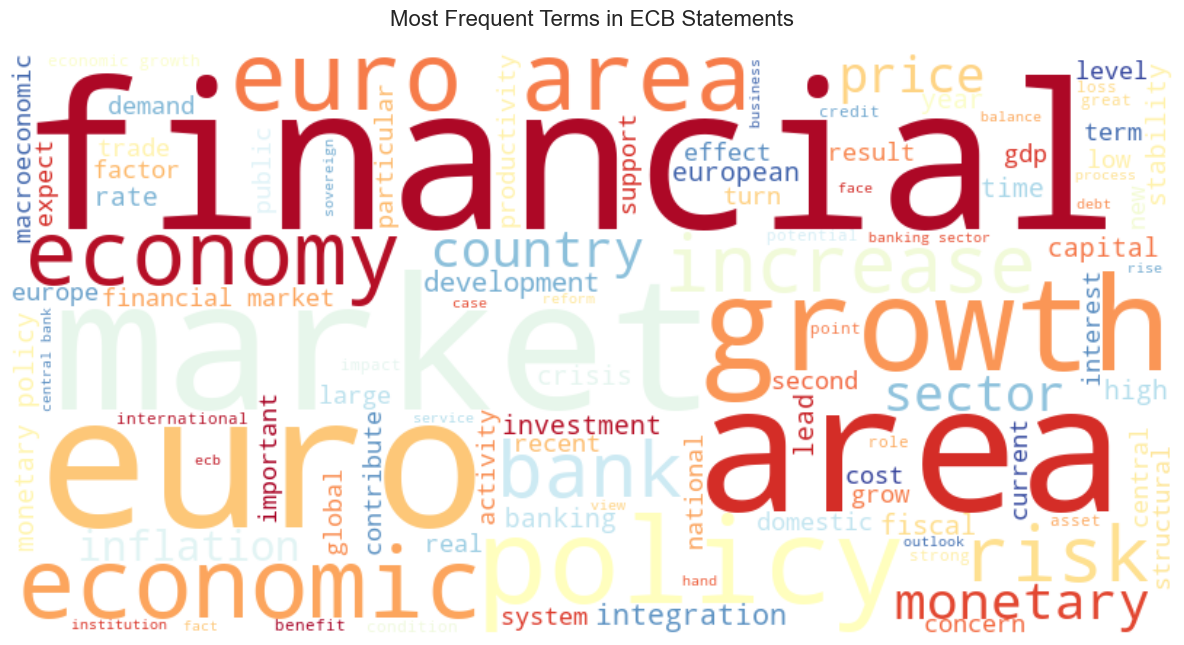
💡Insight: Try deleting the lines of code that remove stopwords. How does this change the visualisation? Are there any other stopwords you’d remove aside from the ones we’ve already removed from the data?
Token Length Analysis by Sentiment
Let’s analyze the distribution of statement lengths by sentiment:
# Calculate number of tokens per statement
ecb_data['n_tokens'] = ecb_data['text_clean'].str.split().str.len()

# Create histogram❓Question: How does token count for documents vary by sentiment?
Supervised learning example: using tokens as features to identify positive ECB sentiment (30 minutes)
We can use our machine learning skills to predict whether an ECB statement expresses positive or negative sentiment.
Predictive Modeling Setup
# Convert sparse matrix to dense array and create DataFrame
X = pd.DataFrame(doc_term_matrix.toarray(), columns=feature_names)
y = ecb_data['sentiment']  # Use numeric labels (1 = positive, 0 = negative)

print(f"Feature matrix shape: {X.shape}")
print(f"Target distribution:\n{y.value_counts()}")

# Create train-test split
Building a Light Gradient Boosted Model
LightGBM and XGBoost are both gradient boosting algorithms that build sequential decision trees, but LightGBM is typically faster and more memory-efficient, especially on large datasets. The key difference is in how they grow trees: XGBoost grows trees level-by-level (depth-wise), while LightGBM grows leaf-by-leaf (choosing the split that reduces error most), which often leads to faster training with similar or better accuracy. Try building a model with the following hyperparameters:
feature_fraction = mtry(defined in the code)- 2,000 estimators
- Learning rate of 0.01
- Feature importance type set to “gain”
# Calculate mtry (square root of number of features / number of features)
mtry = int(np.sqrt(X_train.shape[1]))/X_train.shape[1]

# Create LightGBM model

# Fit the model
Variable Importance Analysis
Variable importance plots show which features (variables) contribute most to a model’s predictions. They rank features by how much they improve the model’s performance, helping you understand what drives your predictions. How to read them:
- Features are listed vertically (top = most important)
- Bar length or score shows relative importance
- Longer bars = that feature has more influence on predictions
Why they’re useful:
- Interpretability: Understand what your model relies on
- Feature selection: Identify which variables you can drop
- Domain validation: Check if important features make sense for your problem
- Debugging: Spot if the model is using unexpected/problematic features
📝 Note: Unlike Lasso regression coefficients, variable importance scores only tell you how much a feature matters, not which direction (positive or negative effect). A highly important feature could be pushing predictions either way!
# Get feature importances
feature_importance = pd.DataFrame({
    'feature': feature_names,
    'importance': lgb_model.feature_importances_
}).sort_values('importance', ascending=True).tail(20)

# Create feature importance plot
plt.figure(figsize=(10, 8))
plt.barh(range(len(feature_importance)), feature_importance['importance'])
plt.yticks(range(len(feature_importance)), feature_importance['feature'])
plt.xlabel('Importance')
plt.title('Top 20 Most Important Features (LightGBM)')
plt.grid(True, alpha=0.3)
plt.tight_layout()
plt.show()

print("Top 10 most important features:")
print(feature_importance.tail(10)[['feature', 'importance']])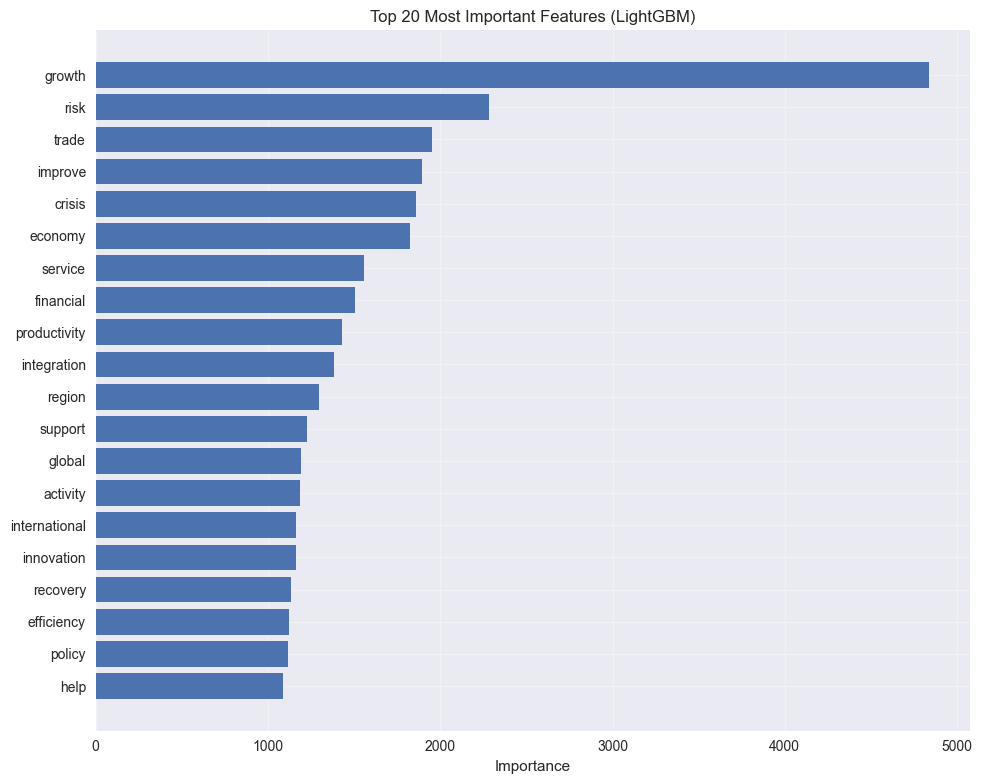
Top 10 most important features:
          feature   importance
502   integration  1385.382330
720  productivity  1427.101442
354     financial  1506.942541
832       service  1558.899241
264       economy  1823.397919
178        crisis  1857.511730
463       improve  1892.166666
942         trade  1949.947062
809          risk  2285.369395
428        growth  4834.307652
SHAP (Shapley) Values
SHAP values extend variable importance by providing two critical insights: - Influence by observation: See how each feature contributed to individual predictions, not just overall importance. This lets you explain “why did the model predict THIS specific statement as negative?” - Direction of influence: SHAP values are signed (positive or negative), showing whether a feature pushed the prediction up or down. For example, you can see that “high positive_words_count increased the probability of positive sentiment by 0.15” for a specific statement.
# Create SHAP explainer
explainer = shap.TreeExplainer(lgb_model)
shap_values = explainer.shap_values(X_train.iloc[:1000])

# Bee swarm plot
plt.figure(figsize=(12, 8))
shap.summary_plot(
    shap_values,
    X_train.iloc[:1000],
    feature_names=feature_names,
    plot_type="dot",
    max_display=20,
    show=False,
)
plt.title("SHAP Bee Swarm Plot - Top 20 Features")
plt.xlabel("SHAP value (impact on model output)")
plt.tight_layout()
plt.show()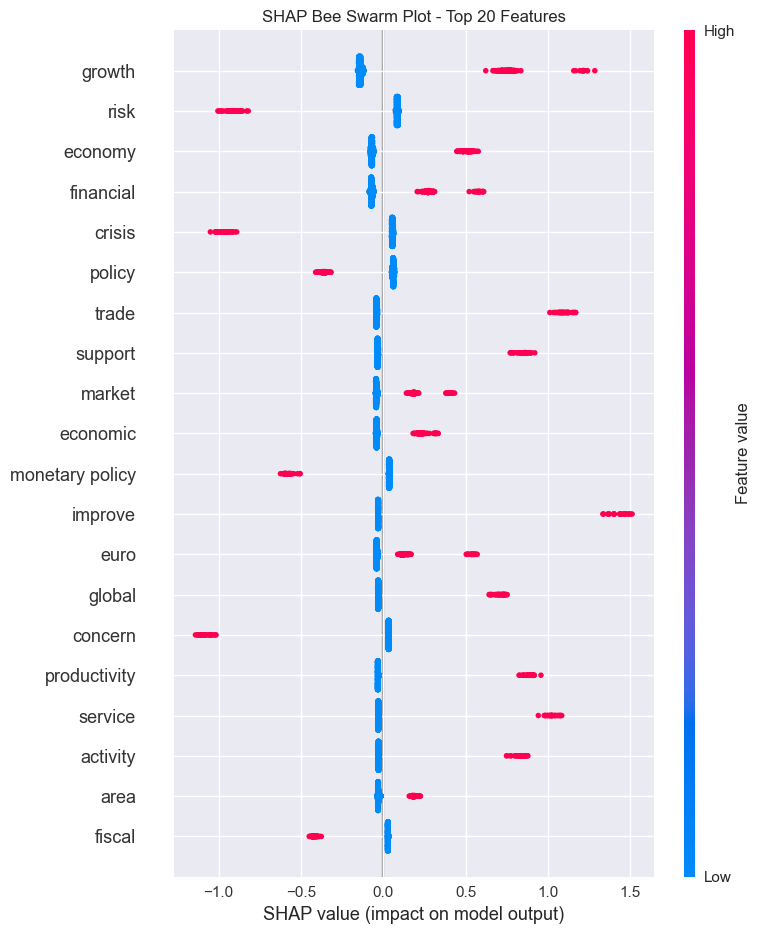
🗣️ CLASSROOM DISCUSSION:
Which features are most important for predicting ECB sentiment? What economic themes emerge?
Model Evaluation
Let’s no evaluate the model using a confusion matrix.
# Make predictions

# Create a Confusion matrix

# Calculate F1 score❓Question: How well does our model perform on the test set?
BERTopic: A Modular Pipeline
BERTopic isn’t a single model so much as it’s a pipeline that combines multiple techniques:
- Sentence Transformers: Creates dense vector embeddings that capture semantic meaning of documents
- UMAP (Uniform Manifold Approximation and Projection): Reduces embedding dimensions while preserving document relationships
- HDBSCAN (Hierarchical Density-Based Clustering): Groups similar documents into clusters
- c-TF-IDF (class-based TF-IDF): Extracts representative words for each topic cluster
- CountVectorizer (optional): Tokenizes and vectorizes text for the c-TF-IDF step
This modular design means you can swap components (e.g., use different embeddings or clustering algorithms) while keeping the overall framework. Each model handles a specific step: embeddings → dimensionality reduction → clustering → topic representation.
🛑 Why we keep stopwords in BERTopic: Unlike traditional bag-of-words approaches, BERTopic uses sentence transformers that need full sentences (including stopwords like “the”, “is”, “will”) to capture semantic context and relationships. The c-TF-IDF component automatically downweights common words, so we get better embeddings without losing interpretability. We only filter stopwords when displaying topic words to humans, not during modeling!
# Filter for longer statements
statements_for_topics = ecb_data[ecb_data["text"].str.len() > 30].copy()

def preprocess_for_bertopic(text):
    """Enhanced preprocessing for BERTopic with financial stopword removal"""
    if pd.isna(text):
        return ""

    # Basic cleaning
    text = str(text).lower()
    text = re.sub(r"http\S+|www\S+|https\S+", "", text, flags=re.MULTILINE)
    text = re.sub(r"[^\w\s]", " ", text)
    text = " ".join(text.split())

    # Remove stopwords
    stop_words = set(stopwords.words("english"))
    custom_stopwords = {
        "ecb", "bank", "central", "said", "one", "would", "also",
        "get", "go", "see", "well", "may", "could", "will", "shall",
        "percent", "per", "cent", "euro", "european", "committee",
        "council", "meeting", "decision", "policy", "monetary"
    }
    stop_words.update(custom_stopwords)

    # Tokenize and remove stopwords
    tokens = word_tokenize(text)
    tokens = [token for token in tokens if token not in stop_words and len(token) > 2]
    text = " ".join(tokens)

    return text

statements_for_topics["text_bertopic"] = statements_for_topics["text"].apply(preprocess_for_bertopic)
statements_for_topics = statements_for_topics[statements_for_topics["text_bertopic"].str.len() > 15]

print(f"Number of statements for topic modeling: {len(statements_for_topics)}")
# Filter for longer statements
statements_for_topics = ecb_data[ecb_data["text"].str.len() > 30].copy()
def preprocess_for_bertopic(text):
"""Basic preprocessing for BERTopic without stopword removal"""
if pd.isna(text):
return ""
# Basic cleaning
text = str(text).lower()
text = re.sub(r"http\S+|www\S+|https\S+", "", text, flags=re.MULTILINE)
text = re.sub(r"[^\w\s]", " ", text)
text = " ".join(text.split())
return text
statements_for_topics["text_bertopic"] = statements_for_topics["text"].apply(preprocess_for_bertopic)
statements_for_topics = statements_for_topics[statements_for_topics["text_bertopic"].str.len() > 15]
print(f"Number of statements for topic modeling: {len(statements_for_topics)}")Running BERTopic
# Data diagnostics
print("Data diagnostics:")
print(f"Number of documents: {len(statements_for_topics)}")
print(f"Average text length: {statements_for_topics['text_bertopic'].str.len().mean():.1f}")

# Clean data
statements_clean = statements_for_topics[statements_for_topics['text_bertopic'].str.len() > 10].copy()
print(f"Documents after cleaning: {len(statements_clean)}")

# BERTopic model
topic_model = BERTopic(
    language="english",
    calculate_probabilities=False,
    verbose=True,
    min_topic_size=10
)

try:
    all_texts = statements_clean['text_bertopic'].tolist()
    print(f"Running topic modeling with {len(all_texts)} documents...")
    topics_final = topic_model.fit_transform(all_texts)

    print(f"Topic modeling successful! Found {len(topic_model.get_topic_info())} topics")

    # Show topic info
    topic_info = topic_model.get_topic_info()
    print(f"\nFinal result: {len(topic_info)} topics found")
    print("\nTopic overview:")
    print(topic_info)

except Exception as e:
    print(f"Error with topic modeling: {e}")
2026-03-09 09:25:18,249 - BERTopic - Embedding - Transforming documents to embeddings.
Data diagnostics:
Number of documents: 2563
Average text length: 171.7
Documents after cleaning: 2563
Running topic modeling with 2563 documents...
Batches: 100%|██████████| 81/81 [00:08<00:00, 10.01it/s]
2026-03-09 09:25:28,762 - BERTopic - Embedding - Completed ✓
2026-03-09 09:25:28,762 - BERTopic - Dimensionality - Fitting the dimensionality reduction algorithm
2026-03-09 09:25:43,610 - BERTopic - Dimensionality - Completed ✓
2026-03-09 09:25:43,612 - BERTopic - Cluster - Start clustering the reduced embeddings
2026-03-09 09:25:43,710 - BERTopic - Cluster - Completed ✓
2026-03-09 09:25:43,715 - BERTopic - Representation - Fine-tuning topics using representation models.
2026-03-09 09:25:43,778 - BERTopic - Representation - Completed ✓
Topic modeling successful! Found 44 topics
Final result: 44 topics found
Topic overview:
Topic Count Name \
0 -1 1000 -1_the_in_of_and
1 0 180 0_euro_area_the_to
2 1 138 1_financial_integration_and_capital
3 2 95 2_fiscal_sustainability_finances_public
4 3 72 3_inflation_expectations_outlook_that
5 4 69 4_banks_profitability_bank_resolution
6 5 68 5_ecb_ecbs_the_of
7 6 67 6_area_euro_growth_recovery
8 7 59 7_monetary_policy_the_to
9 8 53 8_euro_financial_markets_integration
10 9 51 9_demand_domestic_consumption_growth
11 10 51 10_trade_area_eu_euro
12 11 44 11_interest_rates_on_low
13 12 41 12_crisis_that_the_it
14 13 40 13_banking_sector_consolidation_integration
15 14 28 14_deficit_gdp_account_us
16 15 28 15_emerging_economies_global_world
17 16 27 16_productivity_growth_factor_total
18 17 27 17_risk_downside_risks_could
19 18 26 18_investors_complex_risk_ratings
20 19 26 19_balance_sovereign_sheets_banks
21 20 24 20_ageing_population_public_finances
22 21 24 21_fiscal_is_policies_euro
23 22 23 22_retail_sepa_payment_payments
24 23 22 23_policymakers_decisions_accountability_policy
25 24 21 24_growth_economic_employment_wellbeing
26 25 20 25_investment_market_scale_integration
27 26 19 26_union_monetary_emu_economic
28 27 19 27_price_stability_upside_risks
29 28 18 28_macroprudential_to_instruments_prudential
30 29 17 29_loans_lending_credit_corporations
31 30 16 30_assets_these_funds_triggered
32 31 15 31_european_integration_market_services
33 32 15 32_globalisation_crossborder_goods_trade
34 33 15 33_macroeconomic_programmes_policies_was
35 34 14 34_banking_system_positive_nonbanks
36 35 13 35_central_bankers_banks_credibility
37 36 12 36_leverage_derivatives_haircuts_leveraged
38 37 12 37_challenges_european_banking_sector
39 38 12 38_foreign_direct_fdi_investment
40 39 11 39_stability_financial_unwinding_implications
41 40 11 40_diffusion_technologies_new_technological
42 41 10 41_considerations_personal_my_however
43 42 10 42_central_inflation_challenge_distortion
Representation \
0 [the, in, of, and, to, is, as, that, for, have]
1 [euro, area, the, to, that, of, in, for, is, as]
2 [financial, integration, and, capital, markets...
3 [fiscal, sustainability, finances, public, tax...
4 [inflation, expectations, outlook, that, on, t...
5 [banks, profitability, bank, resolution, to, l...
6 [ecb, ecbs, the, of, monetary, policy, that, t...
7 [area, euro, growth, recovery, economic, in, h...
8 [monetary, policy, the, to, in, is, that, anal...
9 [euro, financial, markets, integration, area, ...
10 [demand, domestic, consumption, growth, recove...
11 [trade, area, eu, euro, integration, the, glob...
12 [interest, rates, on, low, rate, real, would, ...
13 [crisis, that, the, it, great, financial, of, ...
14 [banking, sector, consolidation, integration, ...
15 [deficit, gdp, account, us, 2010, current, in,...
16 [emerging, economies, global, world, asia, gro...
17 [productivity, growth, factor, total, in, by, ...
18 [risk, downside, risks, could, prices, form, p...
19 [investors, complex, risk, ratings, risks, mod...
20 [balance, sovereign, sheets, banks, sheet, deb...
21 [ageing, population, public, finances, fiscal,...
22 [fiscal, is, policies, euro, area, discipline,...
23 [retail, sepa, payment, payments, systems, ele...
24 [policymakers, decisions, accountability, poli...
25 [growth, economic, employment, wellbeing, sust...
26 [investment, market, scale, integration, firms...
27 [union, monetary, emu, economic, the, unions, ...
28 [price, stability, upside, risks, analysis, me...
29 [macroprudential, to, instruments, prudential,...
30 [loans, lending, credit, corporations, loan, n...
31 [assets, these, funds, triggered, redemptions,...
32 [european, integration, market, services, infr...
33 [globalisation, crossborder, goods, trade, lin...
34 [macroeconomic, programmes, policies, was, int...
35 [banking, system, positive, nonbanks, intercon...
36 [central, bankers, banks, credibility, communi...
37 [leverage, derivatives, haircuts, leveraged, m...
38 [challenges, european, banking, sector, proble...
39 [foreign, direct, fdi, investment, inward, out...
40 [stability, financial, unwinding, implications...
41 [diffusion, technologies, new, technological, ...
42 [considerations, personal, my, however, views,...
43 [central, inflation, challenge, distortion, ba...
Representative_Docs
0 [on the other hand if the functioning of the c...
1 [first the nature of the inflation shock we ar...
2 [as i have already mentioned financial integra...
3 [however the benefits from expansionary polici...
4 [the economy may then enter on a selfsustainin...
5 [at the same time market valuations of banks h...
6 [a recent ecb study on eu banking structures e...
7 [the ongoing economic expansion of the euro ar...
8 [while the first phase of the crisis can be in...
9 [the euro and the financial markets the creati...
10 [the recovery has been driven almost entirely ...
11 [this is mainly due to more sustained growth i...
12 [on the asset side the flattening of the term ...
13 [the view that crisis resolution mechanisms we...
14 [this work is particularly relevant for the on...
15 [the issue of a large and growing us current a...
16 [all in all the growth in the economic weight ...
17 [most studies point to the potential competiti...
18 [in principle such effects should normally be ...
19 [similarly inadequate information about the qu...
20 [the justification for this threshold is twofo...
21 [the prospective budgetary costs of population...
22 [the fiscal component of sound finances failin...
23 [it acts as an engine for creating a more inte...
24 [apart from the wellknown recognition and deci...
25 [to build with passion and vigour a shared fut...
26 [this could take the form of continued consoli...
27 [during the years leading up to emu indeed sev...
28 [in addition our monetary analysis points to u...
29 [the capital and borrowerbased macroprudential...
30 [moreover net demand for all types of loans ha...
31 [18 such spirals could be triggered if funds w...
32 [at the european level authorities are well aw...
33 [if we define globalisation as the increasing ...
34 [this development was unwarranted given the un...
35 [in addition as was shown yesterday there is s...
36 [incidentally the identification of the distur...
37 [15 for example taking the financial reporting...
38 [one of the practical problems when following ...
39 [gross foreign direct investment fdi transacti...
40 [for years the problem of the sustainability o...
41 [for instance a recent ecb survey of large eur...
42 [however all this has to be weighed against th...
43 [while my comments so far about technical prog...Exploring Topics
# Define stopwords
stop_words = set(stopwords.words("english"))

# Display top words for each topic (filtered)
print("\nECB Topics and their representative words:")
for topic_num in range(min(8, len(topic_info) - 1)):
    if topic_num != -1:
        topic_words = topic_model.get_topic(topic_num)
        # Filter out stopwords, keeping enough to get 10 non-stopword words
        words = []
        for word, _ in topic_words:
            if word not in stop_words:
                words.append(word)
            if len(words) == 10:
                break
        print(f"Topic {topic_num+1}: {', '.join(words)}")
ECB Topics and their representative words:
Topic 1: euro, area
Topic 2: financial, integration, capital, markets, development, growth, allocation
Topic 3: fiscal, sustainability, finances, public, tax, imbalances
Topic 4: inflation, expectations, outlook, medium
Topic 5: banks, profitability, bank, resolution, losses, would
Topic 6: ecb, ecbs, monetary, policy
Topic 7: area, euro, growth, recovery, economic, demand, domestic
Topic 8: monetary, policy, analysis❓Question: What do each of these topics mean?
Topic Visualizations
# Create visualizations
try:
    # Topic word scores
    fig1 = topic_model.visualize_barchart(top_k_topics=min(8, len(topic_info)-1), n_words=10, height=400)
    fig1.show()

    # Topic similarity
    fig2 = topic_model.visualize_topics(height=600)
    fig2.show()

except Exception as e:
    print(f"Visualization error: {e}")
    print("Creating alternative visualizations...")

    # Alternative: horizontal bar plot with topic word labels
    plt.figure(figsize=(12, 8))
    topic_counts = topic_info[topic_info['Topic'] != -1].head(10)

    if len(topic_counts) > 0:
        # Sort by topic number to ensure proper order
        topic_counts = topic_counts.sort_values('Topic')

        # Create topic labels with top 5 words (filtered for stopwords, adding 1 to topic numbers)
        topic_labels = []
        for topic_num in topic_counts['Topic']:
            try:
                topic_words = topic_model.get_topic(topic_num)
                # Filter out stopwords and get top 5 remaining words
                top_words = []
                for word, _ in topic_words:
                    if word not in stop_words:
                        top_words.append(word)
                    if len(top_words) == 5:
                        break
                label = f"T{topic_num + 1}: {', '.join(top_words)}"  # Add 1 to topic number
                topic_labels.append(label)
            except:
                topic_labels.append(f"T{topic_num + 1}: (words unavailable)")  # Add 1 to topic number

        # Reverse the order so Topic 1 (originally 0) is at the top
        topic_labels_reversed = topic_labels[::-1]
        counts_reversed = topic_counts['Count'].values[::-1]

        # Create horizontal bar chart
        y_pos = range(len(topic_counts))
        plt.barh(y_pos, counts_reversed, color='steelblue', alpha=0.7)

        # Customize the plot
        plt.yticks(y_pos, topic_labels_reversed)
        plt.xlabel('Number of Documents')
        plt.title('Document Count by ECB Topic (with Top 5 Words)')
        plt.grid(True, alpha=0.3, axis='x')

        # Adjust layout to accommodate longer labels
        plt.tight_layout()
        plt.subplots_adjust(left=0.4)  # Make room for topic labels
        plt.show()
    else:
        print("No topics available for visualization")
Visualization error: BERTopic.visualize_barchart() got an unexpected keyword argument 'top_k_topics'
Creating alternative visualizations...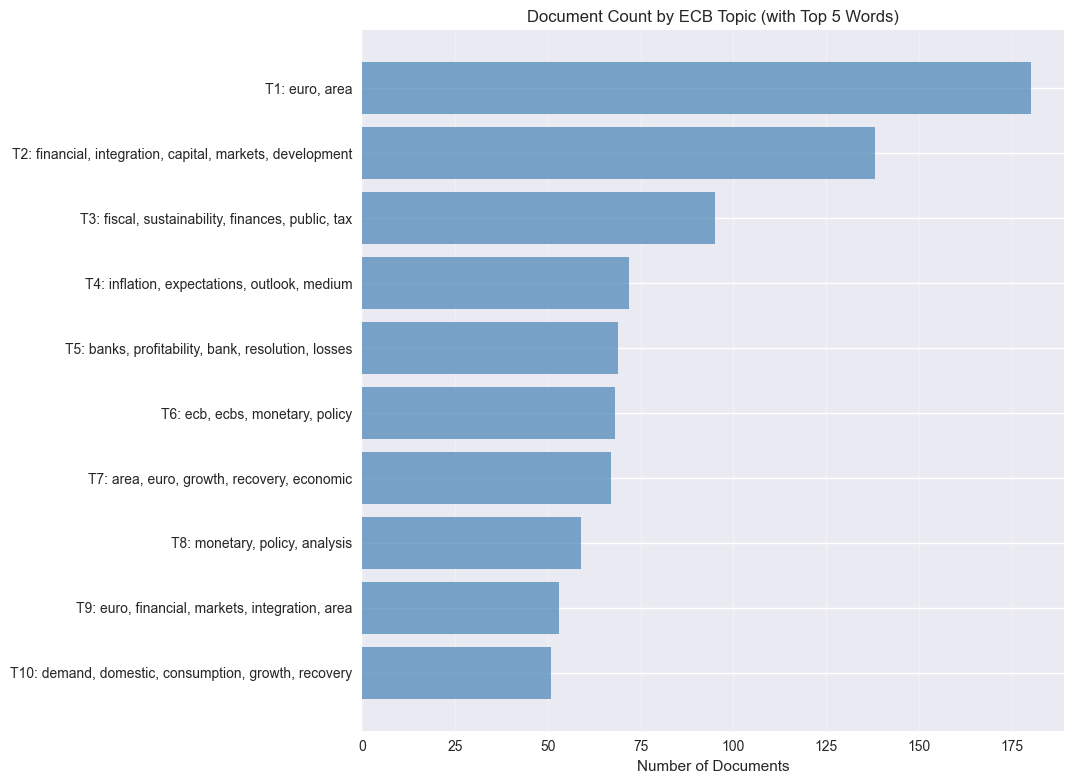
BERTopic by sentiment
# Filter for positive and negative sentiments
positive_data = statements_for_topics[statements_for_topics['sentiment_label'] == 'Positive'].copy()
negative_data = statements_for_topics[statements_for_topics['sentiment_label'] == 'Negative'].copy()

print(f"Positive statements: {len(positive_data)}")
print(f"Negative statements: {len(negative_data)}")

# Function to run BERTopic on a subset
def run_bertopic_by_sentiment(data, sentiment_type):
    """Run BERTopic on statements filtered by sentiment"""

    if len(data) < 10:
        print(f"\nNot enough {sentiment_type} statements for topic modeling (minimum 10 required)")
        return None, None

    print(f"\n{'='*60}")
    print(f"BERTopic Analysis - {sentiment_type} Sentiment")
    print(f"{'='*60}")

    # Prepare documents
    documents = data['text_bertopic'].tolist()

    # Initialize BERTopic
    vectorizer_model = CountVectorizer(min_df=2, max_df=0.95)
    topic_model = BERTopic(
        vectorizer_model=vectorizer_model,
        min_topic_size=10,
        nr_topics='auto',
        verbose=True
    )

    # Fit the model
    topics, probabilities = topic_model.fit_transform(documents)

    # Get topic info
    topic_info = topic_model.get_topic_info()
    print(f"\nNumber of topics found: {len(topic_info) - 1}")  # -1 to exclude outlier topic
    print(f"\nTopic distribution:")
    print(topic_info.head(10))

    # Display top words for each topic (filtered for stopwords)
    stop_words = set(stopwords.words("english"))

    print(f"\n{sentiment_type} Topics and their representative words:")
    for topic_num in range(min(8, len(topic_info) - 1)):
        if topic_num != -1:
            topic_words = topic_model.get_topic(topic_num)
            # Filter out stopwords and get up to 10 remaining words
            words = []
            for word, _ in topic_words:
                if word not in stop_words:
                    words.append(word)
                if len(words) == 10:
                    break
            print(f"Topic {topic_num}: {', '.join(words)}")

    return topic_model, topic_info

# Run BERTopic for Positive sentiment
positive_model, positive_info = run_bertopic_by_sentiment(positive_data, "Positive")

# Run BERTopic for Negative sentiment
negative_model, negative_info = run_bertopic_by_sentiment(negative_data, "Negative")
2026-03-09 09:38:03,082 - BERTopic - Embedding - Transforming documents to embeddings.
Positive statements: 954
Negative statements: 1609
============================================================
BERTopic Analysis - Positive Sentiment
============================================================
Batches: 100%|██████████| 30/30 [00:02<00:00, 10.79it/s]
2026-03-09 09:38:07,543 - BERTopic - Embedding - Completed ✓
2026-03-09 09:38:07,543 - BERTopic - Dimensionality - Fitting the dimensionality reduction algorithm
2026-03-09 09:38:08,524 - BERTopic - Dimensionality - Completed ✓
2026-03-09 09:38:08,524 - BERTopic - Cluster - Start clustering the reduced embeddings
2026-03-09 09:38:08,577 - BERTopic - Cluster - Completed ✓
2026-03-09 09:38:08,579 - BERTopic - Representation - Extracting topics using c-TF-IDF for topic reduction.
2026-03-09 09:38:08,626 - BERTopic - Representation - Completed ✓
2026-03-09 09:38:08,626 - BERTopic - Topic reduction - Reducing number of topics
2026-03-09 09:38:08,630 - BERTopic - Representation - Fine-tuning topics using representation models.
2026-03-09 09:38:08,651 - BERTopic - Representation - Completed ✓
2026-03-09 09:38:08,651 - BERTopic - Topic reduction - Reduced number of topics from 13 to 13
2026-03-09 09:38:08,704 - BERTopic - Embedding - Transforming documents to embeddings.
Number of topics found: 12
Topic distribution:
Topic Count Name \
0 -1 153 -1_has_market_for_investment
1 0 283 0_economic_productivity_is_has
2 1 139 1_financial_integration_markets_development
3 2 104 2_euro_financial_markets_integration
4 3 81 3_area_euro_economic_demand
5 4 51 4_banking_sector_banks_eu
6 5 49 5_area_trade_euro_eu
7 6 25 6_credit_sector_loans_nonfinancial
8 7 17 7_retail_payment_payments_sepa
9 8 14 8_structural_convergence_reforms_economic
Representation \
0 [has, market, for, investment, as, euro, finan...
1 [economic, productivity, is, has, by, trade, g...
2 [financial, integration, markets, development,...
3 [euro, financial, markets, integration, area, ...
4 [area, euro, economic, demand, recovery, activ...
5 [banking, sector, banks, eu, consolidation, is...
6 [area, trade, euro, eu, integration, europe, w...
7 [credit, sector, loans, nonfinancial, lending,...
8 [retail, payment, payments, sepa, services, sy...
9 [structural, convergence, reforms, economic, i...
Representative_Docs
0 [lending rates for euro area firms and househo...
1 [moreover in many of these emerging economies ...
2 [financial integration is a key factor in the ...
3 [the euro has acted as a catalyst for the inte...
4 [economic activity in the euro area is also ex...
5 [these findings are particularly relevant for ...
6 [external factors such as more sustained growt...
7 [the transmission of the improvement in banks ...
8 [sizeable financial benefits are expected from...
9 [so taken together structural reforms promote ...
Positive Topics and their representative words:
Topic 0: economic, productivity, trade, global, demand
Topic 1: financial, integration, markets, development, capital, economic, system, international
Topic 2: euro, financial, markets, integration, area, market, european, currency, introduction
Topic 3: area, euro, economic, demand, recovery, activity, labour, domestic
Topic 4: banking, sector, banks, eu, consolidation, integration, intermediation, european
Topic 5: area, trade, euro, eu, integration, europe, within, global
Topic 6: credit, sector, loans, nonfinancial, lending, corporations, funding, bank
Topic 7: retail, payment, payments, sepa, services, systems, competition, innovation
============================================================
BERTopic Analysis - Negative Sentiment
============================================================
Batches: 100%|██████████| 51/51 [00:04<00:00, 10.63it/s]
2026-03-09 09:38:15,051 - BERTopic - Embedding - Completed ✓
2026-03-09 09:38:15,051 - BERTopic - Dimensionality - Fitting the dimensionality reduction algorithm
2026-03-09 09:38:18,315 - BERTopic - Dimensionality - Completed ✓
2026-03-09 09:38:18,317 - BERTopic - Cluster - Start clustering the reduced embeddings
2026-03-09 09:38:18,402 - BERTopic - Cluster - Completed ✓
2026-03-09 09:38:18,404 - BERTopic - Representation - Extracting topics using c-TF-IDF for topic reduction.
2026-03-09 09:38:18,451 - BERTopic - Representation - Completed ✓
2026-03-09 09:38:18,451 - BERTopic - Topic reduction - Reducing number of topics
2026-03-09 09:38:18,451 - BERTopic - Representation - Fine-tuning topics using representation models.
2026-03-09 09:38:18,496 - BERTopic - Representation - Completed ✓
2026-03-09 09:38:18,498 - BERTopic - Topic reduction - Reduced number of topics from 27 to 16
Number of topics found: 15
Topic distribution:
Topic Count Name \
0 -1 531 -1_for_would_by_be
1 0 495 0_euro_area_fiscal_for
2 1 280 1_inflation_monetary_policy_price
3 2 63 2_ecb_ecbs_monetary_policy
4 3 51 3_crisis_financial_also_economic
5 4 28 4_risks_downside_risk_growth
6 5 24 5_ageing_population_public_finances
7 6 24 6_deficit_gdp_us_account
8 7 24 7_policymakers_accountability_decisions_their
9 8 16 8_factors_structural_weak_profitability
Representation \
0 [for, would, by, be, financial, it, which, an,...
1 [euro, area, fiscal, for, be, with, it, financ...
2 [inflation, monetary, policy, price, stability...
3 [ecb, ecbs, monetary, policy, for, was, with, ...
4 [crisis, financial, also, economic, it, great,...
5 [risks, downside, risk, growth, could, place, ...
6 [ageing, population, public, finances, for, fi...
7 [deficit, gdp, us, account, current, 2010, uni...
8 [policymakers, accountability, decisions, thei...
9 [factors, structural, weak, profitability, man...
Representative_Docs
0 [the euro area entered the crisis with an inco...
1 [not only do banks in the affected countries o...
2 [there is also the risk that monetary policy i...
3 [first some commentators have stated that sinc...
4 [it is my contention that the main driver of t...
5 [1 yet it was clear that the loss of growth mo...
6 [the prospective budgetary costs of population...
7 [thus from a pure accounting perspective the u...
8 [21 clearly policymakers who rely exclusively ...
9 [in addition to these structural factors the c...
Negative Topics and their representative words:
Topic 0: euro, area, fiscal, financial, european
Topic 1: inflation, monetary, policy, price, stability, rates
Topic 2: ecb, ecbs, monetary, policy, stability, governing
Topic 3: crisis, financial, also, economic, great, lehman
Topic 4: risks, downside, risk, growth, could, place, threat, global, form, prices
Topic 5: ageing, population, public, finances, fiscal, longterm, demographic, pension, costs
Topic 6: deficit, gdp, us, account, current, 2010, united, increase, oil, deficits
Topic 7: policymakers, accountability, decisions, mandate, policy, would, makers, assessments# Visualize Positive Topics
if positive_model is not None:
print("\n" + "="*60)
print("POSITIVE SENTIMENT VISUALIZATIONS")
print("="*60)
try:
fig1 = positive_model.visualize_barchart(top_k_topics=min(8, len(positive_info)-1), n_words=10, height=400)
fig1.show()
fig2 = positive_model.visualize_topics(height=600)
fig2.show()
except Exception as e:
print(f"Visualization error: {e}")
print("Creating alternative visualization...")
plt.figure(figsize=(12, 8))
topic_counts = positive_info[positive_info['Topic'] != -1].head(10)
if len(topic_counts) > 0:
topic_counts = topic_counts.sort_values('Topic')
stop_words = set(stopwords.words("english"))
topic_labels = []
for topic_num in topic_counts['Topic']:
try:
topic_words = positive_model.get_topic(topic_num)
top_words = []
for word, _ in topic_words:
if word not in stop_words:
top_words.append(word)
if len(top_words) == 5:
break
label = f"T{topic_num + 1}: {', '.join(top_words)}"
topic_labels.append(label)
except:
topic_labels.append(f"T{topic_num + 1}: (words unavailable)")
topic_labels_reversed = topic_labels[::-1]
counts_reversed = topic_counts['Count'].values[::-1]
y_pos = range(len(topic_counts))
plt.barh(y_pos, counts_reversed, color='green', alpha=0.7)
plt.yticks(y_pos, topic_labels_reversed)
plt.xlabel('Number of Documents')
plt.title('Document Count by ECB Topic - POSITIVE Sentiment (with Top 5 Words)')
plt.grid(True, alpha=0.3, axis='x')
plt.tight_layout()
plt.subplots_adjust(left=0.4)
plt.show()
# Visualize Negative Topics
if negative_model is not None:
print("\n" + "="*60)
print("NEGATIVE SENTIMENT VISUALIZATIONS")
print("="*60)
try:
fig1 = negative_model.visualize_barchart(top_k_topics=min(8, len(negative_info)-1), n_words=10, height=400)
fig1.show()
fig2 = negative_model.visualize_topics(height=600)
fig2.show()
except Exception as e:
print(f"Visualization error: {e}")
print("Creating alternative visualization...")
plt.figure(figsize=(12, 8))
topic_counts = negative_info[negative_info['Topic'] != -1].head(10)
if len(topic_counts) > 0:
topic_counts = topic_counts.sort_values('Topic')
stop_words = set(stopwords.words("english"))
topic_labels = []
for topic_num in topic_counts['Topic']:
try:
topic_words = negative_model.get_topic(topic_num)
top_words = []
for word, _ in topic_words:
if word not in stop_words:
top_words.append(word)
if len(top_words) == 5:
break
label = f"T{topic_num + 1}: {', '.join(top_words)}"
topic_labels.append(label)
except:
topic_labels.append(f"T{topic_num + 1}: (words unavailable)")
topic_labels_reversed = topic_labels[::-1]
counts_reversed = topic_counts['Count'].values[::-1]
y_pos = range(len(topic_counts))
plt.barh(y_pos, counts_reversed, color='red', alpha=0.7)
plt.yticks(y_pos, topic_labels_reversed)
plt.xlabel('Number of Documents')
plt.title('Document Count by ECB Topic - NEGATIVE Sentiment (with Top 5 Words)')
plt.grid(True, alpha=0.3, axis='x')
plt.tight_layout()
plt.subplots_adjust(left=0.4)
plt.show()============================================================
POSITIVE SENTIMENT VISUALIZATIONS
============================================================
Visualization error: BERTopic.visualize_barchart() got an unexpected keyword argument 'top_k_topics'
Creating alternative visualization...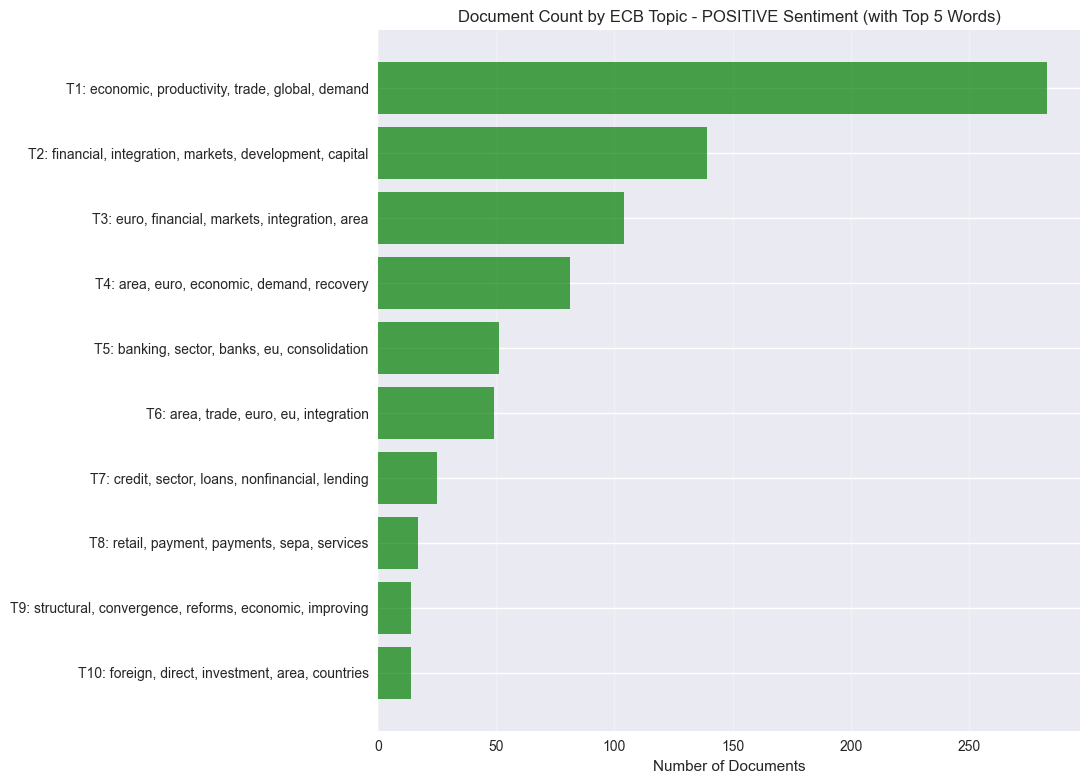
============================================================
NEGATIVE SENTIMENT VISUALIZATIONS
============================================================
Visualization error: BERTopic.visualize_barchart() got an unexpected keyword argument 'top_k_topics'
Creating alternative visualization...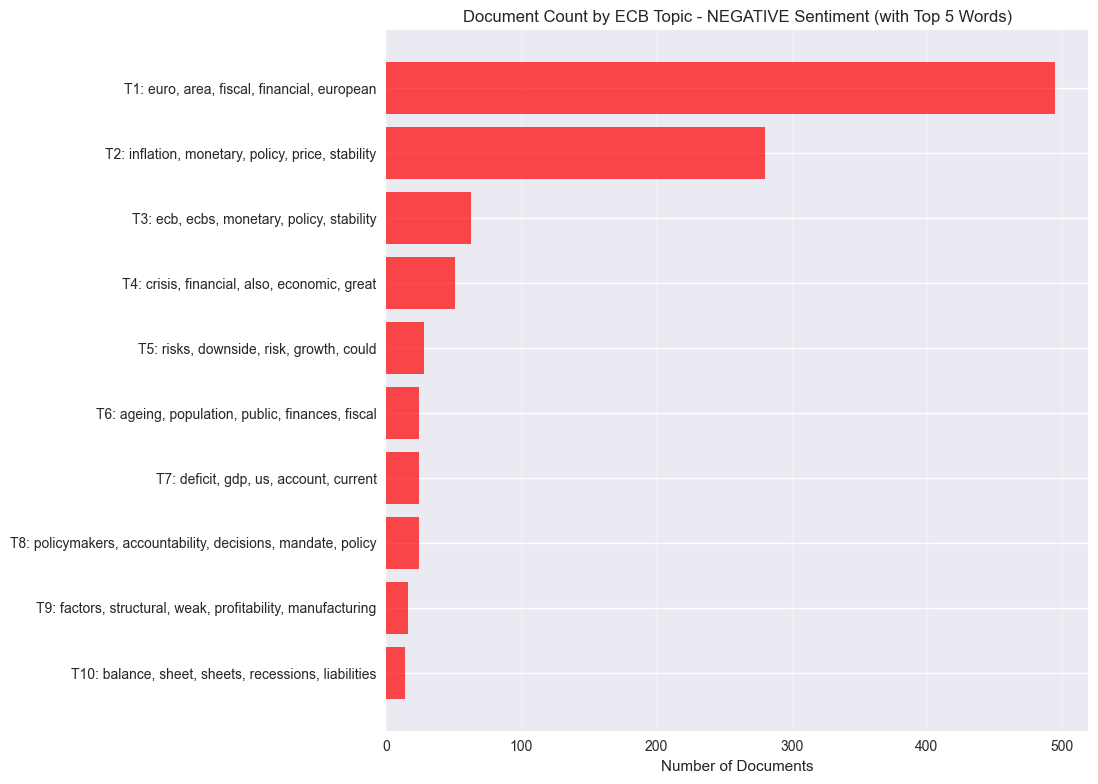
🗣️ CLASSROOM DISCUSSION:
- Which ECB topics seem most coherent and economically meaningful?
- What advantages does BERTopic offer for central bank communication analysis?
Key Differences: BERTopic vs Traditional Methods for Financial Text
| Aspect | Traditional (LDA) | BERTopic |
|---|---|---|
| Topic Number | Manual selection (K) | Automatic optimization |
| Text Representation | Bag-of-words | Transformer embeddings |
| Financial Jargon | Struggles with specialized terms | Better semantic understanding |
| Economic Context | Limited context awareness | Rich contextual relationships |
| Policy Language | Word co-occurrence patterns | Semantic policy relationships |
💡 TAKEAWAY: BERTopic’s transformer-based approach is particularly valuable for financial and economic text analysis. Central bank communications often contain nuanced policy language and technical economic concepts that benefit from BERTopic’s semantic understanding.
Keyness Analysis: Positive vs Negative ECB Sentiment
Keyness is a corpus linguistics technique that identifies which words are statistically unusually frequent in one text group compared to another; here, positive vs negative ECB statements.
Unlike simple word frequency, keyness tells you which terms are distinctive to each sentiment, not merely common overall. A word like financial appears frequently in both groups, so it has low keyness. A word like crisis that appears disproportionately in negative statements has high keyness for that group.
We’ll use log-likelihood (G²) as the keyness statistic. It is robust for unequal corpus sizes (here ~954 positive vs ~1,609 negative statements) and is standard practice in corpus linguistics.
📐 Log-likelihood formula: \[G^2 = 2 \sum O_i \ln\left(\frac{O_i}{E_i}\right)\] where \(O_i\) is the observed count and \(E_i\) is the expected count under the null hypothesis of equal relative frequency. A higher G² = more distinctive. The sign (positive/negative) tells you which group the term favours.
# Split corpus by sentiment
pos_texts = ecb_data[ecb_data['sentiment_label'] == 'Positive']['text_clean'].tolist()
neg_texts = ecb_data[ecb_data['sentiment_label'] == 'Negative']['text_clean'].tolist()

# Build a shared vocabulary from both corpora
cv_keyness = CountVectorizer(max_features=2000, min_df=5, ngram_range=(1, 1),
                             token_pattern=r'\b[a-zA-Z]{3,}\b')
cv_keyness.fit(pos_texts + neg_texts)
vocab = cv_keyness.get_feature_names_out()

# Get term frequencies for each group
pos_matrix = cv_keyness.transform(pos_texts)
neg_matrix = cv_keyness.transform(neg_texts)

pos_freq = np.array(pos_matrix.sum(axis=0)).flatten()  # count per term in positive
neg_freq = np.array(neg_matrix.sum(axis=0)).flatten()  # count per term in negative

# Corpus totals
total_pos = pos_freq.sum()
total_neg = neg_freq.sum()
total     = total_pos + total_neg

# Log-likelihood (G²) keyness
def log_likelihood(o1, o2, total1, total2):
    """Compute signed log-likelihood keyness for each term.
    Positive = term favours corpus 1 (positive sentiment).
    Negative = term favours corpus 2 (negative sentiment).
    """
    n = total1 + total2
    e1 = total1 * (o1 + o2) / n
    e2 = total2 * (o1 + o2) / n
    # Guard against log(0)
    ll = np.where(
        (o1 > 0) & (o2 > 0),
        2 * (o1 * np.log(o1 / e1) + o2 * np.log(o2 / e2)),
        np.where(o1 > 0, 2 * o1 * np.log(o1 / e1), 2 * o2 * np.log(o2 / e2))
    )
    # Sign: positive if over-represented in corpus 1 (positive sentiment)
    sign = np.where(o1 / total1 >= o2 / total2, 1, -1)
    return sign * ll

keyness_scores = log_likelihood(pos_freq, neg_freq, total_pos, total_neg)

keyness_df = pd.DataFrame({
    'term'        : vocab,
    'keyness'     : keyness_scores,
    'pos_count'   : pos_freq.astype(int),
    'neg_count'   : neg_freq.astype(int),
    'pos_freq_pct': (pos_freq / total_pos * 100).round(4),
    'neg_freq_pct': (neg_freq / total_neg * 100).round(4),
}).sort_values('keyness', ascending=False)

print('Top 15 keywords for POSITIVE sentiment:')
print(keyness_df.head(15)[['term','keyness','pos_count','neg_count']].to_string(index=False))
print()
print('Top 15 keywords for NEGATIVE sentiment:')
print(keyness_df.tail(15).sort_values('keyness')[['term','keyness','pos_count','neg_count']].to_string(index=False))
# ── Diverging bar chart of top keywords per sentiment ──
n = 15
top_pos = keyness_df.head(n).copy()
top_neg = keyness_df.tail(n).sort_values('keyness').copy()
plot_df = pd.concat([top_neg, top_pos]).reset_index(drop=True)
colors = ['#d73027' if k < 0 else '#4575b4' for k in plot_df['keyness']]
fig, ax = plt.subplots(figsize=(10, 9))
bars = ax.barh(plot_df['term'], plot_df['keyness'], color=colors, edgecolor='white', linewidth=0.4)
ax.axvline(0, color='black', linewidth=0.8)
ax.set_xlabel('Log-likelihood keyness (G²)', fontsize=12)
ax.set_title('Keyness: Positive vs Negative ECB Sentiment\n'
'(blue = distinctive of positive | red = distinctive of negative)',
fontsize=13, pad=12)
ax.grid(axis='x', alpha=0.3)
plt.tight_layout()
plt.show()❓ Question: Which terms are most distinctive of positive vs negative ECB statements? Do the results match your intuitions about central bank communication?
Summary and Next Steps
In this lab, we’ve explored text analysis applied to European Central Bank statements:
- Financial text preprocessing using Python’s NLP libraries
- Economic document-term matrices for sentiment and topic analysis
- Supervised learning for ECB sentiment classification
- Model interpretation using SHAP values for financial text features
- Modern topic modeling of central bank communications with BERTopic
Key Applications for Financial Text Analysis:
- Central bank communication analysis - Policy stance detection
- Market sentiment analysis - Economic outlook assessment
- Financial news analysis - Automated sentiment scoring
- Regulatory text mining - Policy theme extraction
Extensions to consider:
- Time series analysis of ECB sentiment over economic cycles
- Cross-lingual analysis of multilingual central bank communications
- Aspect-based sentiment analysis for specific policy areas
- Integration with economic indicators for predictive modeling